
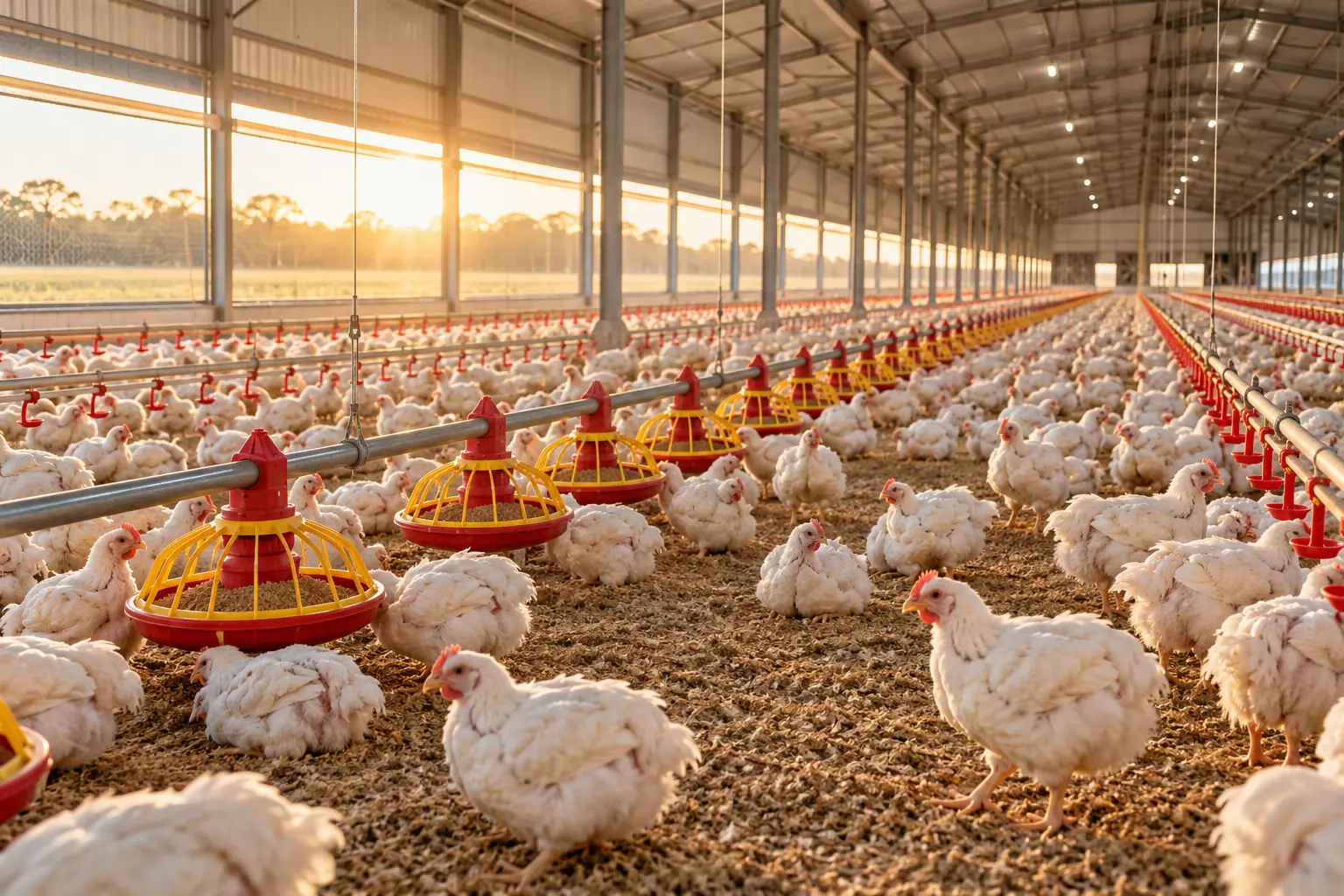
Heat management in a poultry house is a planned process rather than simply switching on a fan at the hottest time. Temperature, humidity, air movement, drinking-water delivery, bird age and equipment condition all influence flock comfort. Prepare before hot weather and review the programme using both house records and bird observations.
Recognise changes early
Panting, wings held away from the body, reduced feeding and altered activity can accompany heat stress. Note whether changes affect the entire house or a particular area. Compare observations with the control-system readings. Severe lethargy or rising mortality calls for prompt action and contact with the farm’s technical and veterinary team.
Read temperature and humidity together
Birds depend on their environment to lose heat, and high humidity can restrict evaporative heat loss. Record both variables at representative locations and at a relevant height. When a sensor reading and flock behaviour do not agree, investigate sensor condition, location and differences within the house.
Prepare equipment before a hot period
Inspect fans, inlets, belts, screens, controls and cooling equipment according to the system’s design and maintenance instructions. Record who checked each item, when, what was found and how it was corrected. Test alarms and verify the farm’s backup-power arrangements as part of that preparation.
Ventilation needs to suit the building and flock. Check airflow paths, obstructions and distribution rather than relying only on the number of fans running. Settings copied from another building may not fit. Review major adjustments with the technical team and check their effect at different locations afterwards.
Check water where the birds drink
Inspect the tank, pump, lines and drinkers for delivery and access, including the far end of the system. Compare consumption trends with conditions in the same house and investigate unusual changes. Water quality and system cleanliness remain part of the programme; greater supply at the source does not fix a blocked line.
Operate cooling with humidity in mind
Evaporative systems must be managed for the prevailing conditions and their design. Inspect pads, water distribution and leaks, then assess the effect using environmental records and bird behaviour. Continue the assessment through the day rather than assuming morning conditions will persist.
Coordinate feeding and daily work
Feeding schedules and flock activities should account for hot periods. Changes in feed, lighting or water additives are not universal instructions for every flock. The responsible specialist needs to consider age, bird type, ration and house conditions. No supplement, electrolyte or medicine dosage is prescribed here.
Make the response plan usable
Keep a short accessible plan showing responsible contacts, alarm reporting, backup-power arrangements and each person’s role during a water, power or ventilation failure. Staff should know who makes decisions and how actions are followed up. A practised plan is more useful than one first read during an emergency.
After a hot period, review environmental data, flock observations, water consumption and equipment faults together. Agree a specific improvement, an owner and a completion date. Repeating that cycle connects observation, maintenance and technical decisions into a stronger management routine.
Sources and further reading
- University of Minnesota Extension — Preventing heat stress in poultry
- Penn State Extension — Hot Weather Management of Poultry
- University of Florida IFAS — Heat Stress Management in Broilers
- University of Arizona Cooperative Extension — Managing chickens during extreme summer temperatures
- Mississippi State University Extension — Prepare Broiler Houses for Summer Weather
- Penn State Extension — Making Water Delivery Count